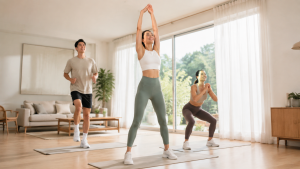
You Already Move More Than You Think
You've got a full calendar, a to-do list that never ends, and zero desire to add "do a workout" to it. The good news: you don't have to. The easiest daily movement for busy people isn't a workout at all - it's a series of micro-movement snacks that take under two minutes each and fit into the cracks of your existing day. I've tested this approach with myself and with clients who hate exercise, and it works because it stops treating movement as a discrete task and starts treating it as a natural part of how you work.
Most advice about fitting in exercise assumes you need a block of time, a plan, and some sweat. That's why it fails for busy people. You're not looking for another obligation. You're looking for a way to feel less stiff, more focused, and more energetic without adding anything to your schedule. Movement snacks deliver exactly that.
The core idea is simple: instead of asking "when can I work out?" ask "where can I sneak in 90 seconds of movement?" The answer is everywhere - between meetings, after emails, before you refill your coffee. Once you start noticing these moments, you'll realize you've been sitting still for hours when you could have been moving without anyone even noticing.
Movement snacks are short, low-effort actions that restore your body and brain. They are not exercise. They are energy management.
Why "More Workouts" Fails Busy People
I've been there. When I first tried to add movement to my day, I made the mistake of scheduling a 20-minute exercise block. I bought a mat, downloaded an app, and set an alarm. It lasted three days. The fourth day I had a crisis at work, skipped it, and never went back. The problem wasn't my motivation - it was that I had created a new obligation that competed with real obligations.
The top-ranking articles on this topic all suggest "quick workouts" or "5-minute routines." They frame exercise as something you have to do, even if it's short. That framing still puts movement in the same mental box as a workout: something to complete, check off, and feel guilty about when you miss it. For busy people, that's a losing game.
What actually works is to stop thinking about exercise entirely. Instead, you think about movement as something that happens naturally when you're talking on the phone, waiting for a file to download, or thinking through a problem. You don't need a plan. You need cues.
The thing nobody tells you about daily movement is that it's not about fitness at all. It's about counteracting the physical cost of sitting. Your body stiffens after 20 minutes of stillness. Your energy drops. Your focus wanders. A two-minute movement snack reverses all three - not because it burns calories, but because it changes your position, gets blood flowing, and resets your nervous system. That's why it works when workouts don't.
The 3-3-3 Rule: Your Built-In Movement Trigger
You've probably heard of the 3-3-3 rule for productivity: three hours of deep work, three meetings, and three personal tasks each day. It's a popular time-management framework because it structures your day without micromanaging it. But the same rule can serve as a movement trigger. Every one of those nine blocks is a natural cue to move.
The 3-3-3 rule works like this: you dedicate three hours to your most important deep work, you have three meetings (or calls or collaborative sessions), and you complete three personal tasks (like emails, admin, or errands). That's nine distinct activity blocks. Between each block, you have a transition - a moment when you're shifting mental gears. That transition is where movement snacks live.
Here's how to apply it: every time you finish a deep work session, a meeting, or a personal task, stand up and do one movement snack. That gives you nine movement snacks per day, each lasting 60-120 seconds. That's 10-18 minutes of movement, spread out, with zero extra time commitment. You're not adding anything to your day - you're just repurposing the gaps you already have.
If you follow a different productivity system, the principle still applies. The key is to attach movement to the natural boundaries of your work. After every email block, before each meeting, after you complete a task - these are your cues. The 3-3-3 rule just makes the cues explicit and predictable.
The Transition Is the Opportunity
Most people treat transitions as wasted time - they refresh their inbox, scroll social media, or just stare at the screen. But a transition is a gift. Your brain is switching contexts, and your body is still in "sitting mode." A quick movement snack turns that dead time into recovery time.
When I first tried this, I used the transition after my morning deep work block. I'd stand up, do 10 calf raises, and roll my shoulders. Within a week, I noticed I didn't feel that mid-morning slump. The stiffness in my lower back disappeared. I wasn't doing anything strenuous - just reminding my body that it could move.
You don't need a fancy app or a special desk. You need to know what movement snacks to do and when to do them. That's what the rest of this article covers.
Movement Snacks: 10 Easy Exercises You Can Do Daily
Movement snacks are short, low-effort actions that you can do anywhere, in any clothes, without breaking a sweat. They are not exercises in the traditional sense - they don't require reps, sets, or equipment. They are simply ways to move your body that feel good and reset your state.
Here are 10 movement snacks I use and recommend. Each takes under two minutes, requires zero equipment, and can be done at your desk, in a hallway, or in a meeting room. I've grouped them by what they target.
For Your Lower Body
- Calf raises: Stand with your feet hip-width apart, rise onto your toes, hold for a second, lower. Do 15-20 reps. This gets blood moving in your legs and wakes up your feet.
- Chair squats: Stand in front of your chair, lower your hips until they hover just above the seat, then stand back up. Do 10-12 reps. This engages your glutes and thighs without any equipment.
- Stair laps: If you have stairs nearby, walk up and down one flight twice. That's 30-60 seconds of cardiovascular work that also strengthens your legs.
- Lunges: Step forward with one leg, lower your hips until both knees are bent about 90 degrees, then push back. Alternate legs for 10 reps total.
For Your Upper Body and Posture
- Shoulder rolls: Roll your shoulders backward in a big circle 10 times, then forward 10 times. This releases tension in your neck and upper back.
- Wall push-ups: Stand an arm's length from a wall, place your hands shoulder-width apart, and do 10 slow push-ups against the wall. This strengthens your chest and arms without lying on the floor.
- Neck tilts: Gently tilt your ear toward your shoulder, hold for 5 seconds, then switch sides. Repeat 3 times each side. This counteracts "tech neck."
- Overhead reaches: Clasp your hands overhead, palms up, and stretch upward as high as you can. Hold for 15 seconds, then relax. This opens your ribcage and improves breathing.
For Your Whole Body
- Marching in place: Lift your knees as high as comfortable while swinging your arms. Do 30 seconds. This is a mini cardio burst that doesn't require any space.
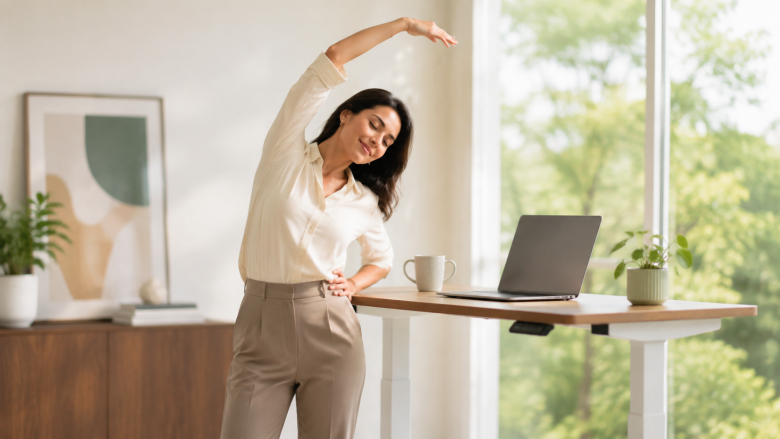
- Standing side bends: Stand with feet hip-width apart, raise one arm overhead, and lean to the opposite side. Hold for 10 seconds, then switch. This stretches your obliques and spine.
These are not exotic moves. They're the kind of thing you'd do while waiting for your coffee to brew. The key is to do them frequently - not to do them perfectly. You don't need to break a sweat. You just need to interrupt sitting.
If you want a more structured daily movement plan, check out our daily movement plan to keep energy up, which builds on these snacks into a full day's rhythm.
How to Pair Movement with Existing Habits
The best way to remember a movement snack is to attach it to something you already do without thinking. This is called habit stacking. You already have dozens of automatic behaviors - checking your phone, starting a video call, finishing a report. Each one can become a cue for movement.
Here's how to set it up: pick one habit you do multiple times a day, and after that habit, do a specific movement snack. For example:
- After you send an email that takes more than 10 minutes to write, stand up and do 10 calf raises.
- Before you join a meeting (especially a video call), do 10 shoulder rolls.
- After you finish a phone call, do a wall push-up set.
- When you get up to refill your water bottle, take a 30-second walk around your floor.
- After you complete a deep work session, march in place for 30 seconds.
The key is to be specific. Don't say "I'll move more often." Say "After every email block, I'll do 10 chair squats." The more specific, the easier it is to remember.
I started with one habit: after every meeting, I'd do a quick stretch. Within a week, it became automatic. I didn't even think about it. My body just knew that the meeting ending meant it was time to stand up. That's the power of pairing movement with existing triggers.
For a deeper dive on structuring your day for energy, see our weekly routine for consistent daily energy, which includes movement as a core pillar.
The 3-3-3 Movement Snack Plan: A Full Day Example
To make this concrete, here's what a day using the 3-3-3 rule with movement snacks might look like. This is a template, not a prescription. Adjust the times and the snacks to fit your schedule.
Morning (Deep Work Block 1)
9:00-10:30 - Deep work on your most important project. At 10:30, you finish. Snack: Stand up, do 10 calf raises, then 5 shoulder rolls. Take a sip of water.
Meeting 1
11:00-11:30 - Team meeting. Before you join, snack: 10 wall push-ups. After the meeting, snack: 10 chair squats.
Personal Task Block 1
11:30-12:00 - Emails and admin. After you send the last email, snack: March in place for 30 seconds.
Lunch Break
Take a real break. If possible, walk for 5 minutes. That's not a snack - that's a bonus.
Afternoon (Deep Work Block 2)
1:30-3:00 - Deep work. At 3:00, snack: Standing side bends, 3 per side.
Meeting 2
3:30-4:00 - Client call. Before the call, snack: Neck tilts. After the call, snack: Stair laps if you have stairs, otherwise 10 lunges.
Personal Task Block 2
4:00-4:30 - Return calls, schedule tomorrow. After you finish, snack: Overhead reaches.
Meeting 3
5:00-5:30 - Catch-up meeting. Before it, snack: Shoulder rolls. After it, snack: Calf raises again.
Evening (Personal Task Block 3)
6:00-6:30 - Personal admin, packing lunch, planning. After you finish, snack: Marching in place.
That's nine snacks, each 1-2 minutes, adding up to about 15 minutes of movement. None of it requires you to change clothes, sweat, or leave your building. And you never had to find a "workout time."
You might notice that you're not doing any "real" exercise. That's okay. The goal is not to get fit. The goal is to feel better and think clearer. If you want more structured movement, you can add it later. But for now, this is enough to make a difference.
If you struggle with the afternoon slump, check out our afternoon reset routine for busy schedules - it uses these same snacks to combat the 3 PM dip.
What to Do When You Forget (or Skip)
Let's be honest: you will forget. Some days you'll be in back-to-back meetings and won't have a single transition. That's fine. The plan is flexible, not rigid. If you miss a snack, don't beat yourself up. Just do the next one.
One thing I learned the hard way: don't try to "catch up" by doing a longer session later. That turns movement back into a workout, which defeats the purpose. If you miss three snacks, just do your next one as planned. The consistency across weeks matters more than perfection on any single day.
Another common issue is feeling self-conscious. You might worry that standing up to do calf raises in the middle of an open office looks strange. Here's the thing: most people won't notice, and if they do, they'll probably assume you're just stretching. To minimize awkwardness, choose snacks that are less conspicuous - like shoulder rolls or neck tilts - when you're in a shared space. Save the stair laps for when you're alone.
Finally, there will be days when you're genuinely too exhausted to move. That's okay. Give yourself permission to skip. But also notice: often, a one-minute snack actually gives you energy rather than taking it away. The hardest part is starting. Once you're moving, it's easy to keep going.
Why Movement Snacks Beat Scheduled Workouts for Energy
I've mentioned that movement snacks are about energy management, not fitness. Here's the science behind it. Prolonged sitting reduces blood flow, slows metabolism, and increases muscle stiffness. Even a short break to stand and move improves circulation and releases endorphins. According to the World Health Organization, physical activity doesn't have to be done in long bouts - it can be accumulated throughout the day. That's exactly what movement snacks do.
The benefit isn't just physical. A 90-second movement break can reset your attention and reduce mental fatigue. When you're stuck on a problem, getting up and moving often helps you think more clearly. That's why the 3-3-3 rule works so well with movement: each transition is an opportunity to clear your head and return refreshed.
Most people don't realize that the feeling of "needing a break" is often your body asking for movement, not for more coffee. You might think you're tired, but you're actually stiff. A quick stretch can do more for your energy than another cup of caffeine.
I've also found that movement snacks improve my posture over time. When I do chair squats and wall push-ups regularly, I naturally sit taller. The stiffness that used to accumulate by late afternoon is gone. I don't have to think about it - the snacks just become part of my day.
Common Misconceptions About Daily Movement
There are three myths that keep busy people from adopting this approach. Let's debunk them.
Myth 1: You Need to Sweat to Get Benefits
False. Movement doesn't have to be intense to be beneficial. Light activity like walking, stretching, and bodyweight exercises at low intensity still improve circulation, reduce stiffness, and support metabolic health. The idea that exercise must be strenuous is a fitness industry myth. For daily energy, low-intensity frequent movement is often more effective than a single intense workout.
Myth 2: You Need at Least 10 Minutes of Continuous Activity
Not true. Research shows that even very short bouts of activity - as little as 1-2 minutes - can have positive effects on blood sugar, mood, and focus. The WHO's guidelines recommend 150 minutes of moderate activity per week, but that can be accumulated in any way. Ten two-minute snacks a day add up to 20 minutes, and that counts.
Myth 3: Movement Snacks Are Only for People Who Are Out of Shape
Wrong. Even athletes and regular exercisers benefit from breaking up long sitting periods. The snacks are not a replacement for structured exercise; they're a complement. They address the specific problem of sedentary work, which exercise alone can't fix. You can run five miles in the morning and still feel stiff and foggy after six hours at a desk.
Understanding these myths helps you see why the movement snack approach is not a compromise - it's a smarter strategy for the reality of your day.
How to Start Tomorrow Morning: A Simple First Step
You don't need to overhaul your entire schedule to start. In fact, the best way to begin is to pick just one movement snack and one trigger. Here's my recommendation:
Tomorrow, after your first meeting or deep work block, stand up and do 10 calf raises. That's it. No app, no plan, no list. Just that one action. When you do it, notice how your body feels. Likely, you'll feel a bit more awake. That's all the motivation you need.
Once that becomes automatic (which takes about a week), add a second snack to a different trigger. Before you know it, you'll have a full day of movement snacks without ever having "exercised."
For more on building a sustainable energy routine, see our daily movement plan to keep energy up and consider pairing it with 7 foods to eat daily for more energy for a complete approach.
The goal is not to become a fitness enthusiast. The goal is to feel better in your body so you can do your best work. Movement snacks are the easiest, most sustainable way to get there - because they don't ask you to change your life. They ask you to notice the moments you already have and use them.
Start small. Start tomorrow. Your body will thank you.